
Official website of Brookhaven Supplies Limited
Buying guides for industrial and commercial supplies
Practical guidance for the person doing the buying — specifications, common mistakes, and the questions worth asking before you commit to consumables, fixings, PPE or janitorial stock.
Written for buyers, not brochures
Each guide takes a category or a purchasing decision and sets out what actually matters: specifications, common mistakes, and the questions worth asking before you commit. Brookhaven Supplies Limited is a non-specialised wholesaler registered in England and Wales under company number 14325680. Our registered address is 18 Park Place, Earley, Reading, England. If a guide raises a question about a specific product, send it through and we will answer it.
Nothing here is a sales page. The point is to give you enough detail to compare two similar products honestly — pack size against pack size, grade against grade — so the item you buy the second time is the same item you bought the first.
What a guide covers
- The specification points worth checking before you buy
- Mistakes that turn a routine order into a delay
- Documentation to ask for, and when to ask
- When a general catalogue is the wrong tool entirely
The guides on this page
Jump to the category you are buying this week. Each section stands on its own.
Guide one
How to choose consumables that get reordered

The reorder test: same reference, same grade, same pack
The best consumable is the one that gets reordered without a second thought, and that usually means consistency over novelty. When you are comparing two similar products, look at pack size, unit count and whether the specification matches what you used last time. A cheaper alternative that changes the size or grade creates hidden cost in rework or waste.
For repeat items, note the exact reference you bought and reorder against it rather than a loose description. A written description such as "blue roll, large" can map to several different products with different sheet counts and ply. A reference maps to one. That single habit removes most of the surprises that show up on a delivery note.
Check before you commit
Pack size, unit count and grade against your last purchase.
Keep a reorder note
Reference, supplier and date. One line per item is enough.

Mixed pallet loads and coil stock — the everyday despatch profile of a broadline wholesaler
Guide two
Fixings and fasteners: what to check before buying
Start with the job the fixing has to do: the substrate, the load, and the environment. A fixing that suits a dry internal wall may not suit an external application or a damp workshop. Check the size and thread against the old part if you are replacing, and check whether the fixing is being used in a safety-critical position.
If it is safety-critical, that is the point to involve a specialist rather than rely on a general catalogue. For routine site fixings, matching the specification you already use is the safest comparison — thread, length, finish and coating all matter when the same fitting has to hold up outside.
Before you order fixings
- Substrate: what is the fixing going into?
- Load and environment: dry internal, damp, or exposed?
- Thread and length matched to the part being replaced
- Safety-critical? Ask a specialist, not a catalogue
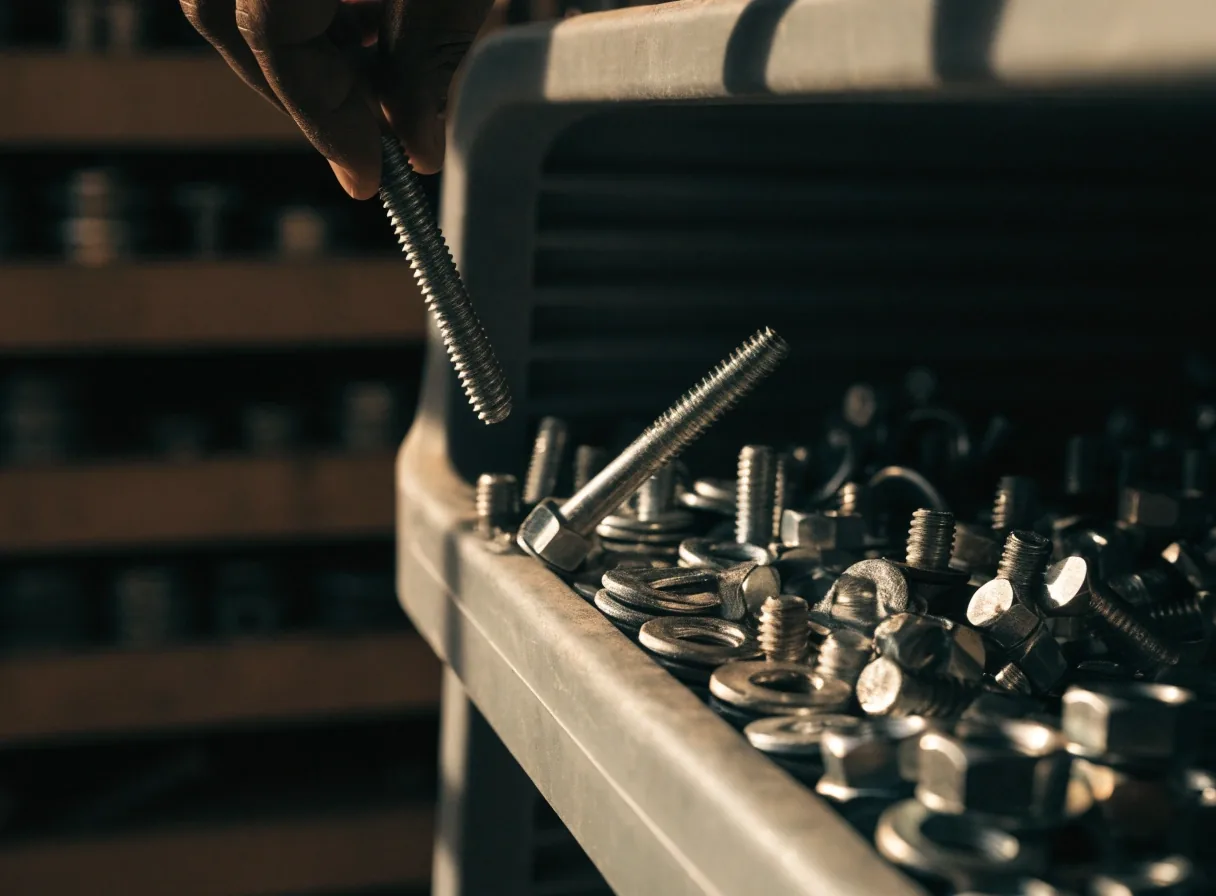
Match thread, length and finish — not just the diameter
The register of guides
Four more chapters, each one a decision you make at the counter
Guide three
PPE: matching the product to the hazard
PPE selection starts with the hazard, not the product name. A glove rated for one chemical may be unsuitable for another, and eye protection for impact is different from eye protection for fine dust. Before buying, identify what the worker is being protected from and check the product's stated protection against that hazard.
Ask for the declaration of conformity and, where relevant, the product data sheet. If a supplier cannot provide documentation for PPE, that is a reason to look elsewhere. Keep the paperwork with the item — not in a folder somewhere else — because the person who needs it is usually the person holding the glove.
Ask for these with the order
Declaration of conformity
The document that states what the item is certified against.
Product data sheet
Relevant where chemical resistance or exposure limits matter.
The stated protection
Check it against the hazard you identified — not the catalogue photo.
No documentation for PPE is a reason to look elsewhere
Guide four
Janitorial supplies: setting up a regime that holds
A cleaning regime fails when it is built around what was on offer rather than what the site actually needs. Count your washrooms, estimate your waste volume, and note the surfaces you are cleaning. Then buy in pack sizes that match your usage cycle, not the smallest unit available.
Dispensers are worth standardising, because mixed dispenser types create waste and confusion — two refill formats, two storage racks, and a queue while someone works out which one fits. Once the regime is set, reorder against it on a schedule rather than waiting for something to run out.

One dispenser format per site — mixed types cost you storage and time
Guide five
Packaging: buying for the despatch you actually do
Packaging decisions should follow your despatch profile. If you send many small parcels, you need different materials from a business moving pallets. Check tape width and adhesive type against the surface and weight, and check wrap gauge against the load. Ordering packaging in the sizes you use most, rather than a spread of sizes you might use, reduces both storage and waste.
If your despatch mix changes seasonally, tell your supplier so pack sizes can be adjusted before the busy weeks, not after. A short note about your peak months is usually enough for a wholesaler to hold the right case sizes for you.
Tape
Width and adhesive type checked against the carton surface and the weight inside it.
Wrap
Gauge matched to the load, not to the cheapest roll on the page.
Case sizes
Stock the sizes you use weekly. The rest can wait until you need them.

Documentation travels with the item — keep the paperwork where the glove is
Guide six
MRO lists: keeping the everyday items under control
The maintenance, repair and operations list is where spend quietly accumulates. Batteries, general sundries, cleaning items, basic fixings: none of it is expensive individually, and all of it is easy to run out of.
The practical fix is a standing list reviewed on a cycle, so you reorder before something stops work. Buying MRO items alongside your other categories consolidates deliveries and reduces the number of separate orders you raise — one delivery note instead of four, one query to chase instead of four.
Guide seven
Comparing a broadline wholesaler with a specialist
Use a broadline wholesaler when your requirement is mixed, repeat and everyday: one account, one enquiry, less admin. Use a category specialist when the requirement is technical and deep product knowledge on one family of items is decisive. Many businesses do both, and that is a sensible split rather than a compromise.
Choose broadline when
- The requirement is mixed across several categories
- Orders repeat on a cycle rather than one-off projects
- You want fewer accounts and fewer delivery notes
Choose a specialist when
- The application is technical and tolerance matters
- Deep knowledge of one product family decides the result
- The purchase is safety-critical or structural
The useful test is whether you need breadth of range or depth of expertise for this particular purchase. If you are unsure, ask and we will tell you which side of the line your requirement sits on — including when that means pointing you to someone else.
Guide eight
Questions worth asking any supplier
These five questions catch most of the problems that turn a straightforward purchase into a delay. They are also the questions we expect from experienced buyers, and we would rather answer them before the order than after.
Ask about documentationDoes the specification match what I ordered last time?
Check the reference, not the description on the order.
Is the documentation available for this product?
Most relevant for PPE and anything used against a hazard.
What is the lead time if it is not held in stock?
Ask before you promise a date to your own customer.
What is the minimum order and pack size?
Pack size drives your storage cost as much as the unit price.
Can I collect?
Collection is often the fastest route when a job is waiting.
Questions we get asked about the guides
Short answers to the three questions that come up most often. If yours is not here, the contact page is the right place for it.
Do you provide declarations of conformity for PPE?
Tell us the specific product you are considering and we will confirm what documentation is available before you commit.
Can you advise on a safety-critical fixing?
For safety-critical or structural applications we will point you to a specialist rather than advise on a general catalogue line.
Are these guides specific to your stock?
They are written around the categories we supply, but the purchasing principles apply to industrial and commercial supplies generally.
Send us the product question and we will answer it
If a guide raised a question about a specific item — a specification, a document, a lead time — put it to us before you order. We are a non-specialised wholesaler, so we would rather tell you which side of the line your requirement sits on than sell you the wrong line.
Brookhaven Supplies Limited
Registered in England and Wales under company number 14325680.
Registered address: 18 Park Place, Earley, Reading, England.
Opening hours
Monday to Friday, 9:00 AM – 6:00 PM